|
Den Hoorn
Smuggler's nest and lieu of pilgrimage
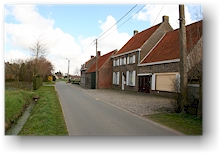 General. General.
Den Hoorn is not a real municipality but this hamlet is the
third largest settlement in Damme, counting a little more than a
thousand souls. The Saint-Ritachurch is the most visited
lieu of pilgrimage in the town of Damme.
Fixed events.
Novena for Saint-Rita in May, village fair end of May.
Name.
In the Middle Ages the present village lay on an island in front
of the Northsea shore. The name "Den Hoorn" is most likely
derived from the sand-bank that was shaped in the form of a horn
(in Flemish horn means "hoorn") that stuck out just above
sea-level.
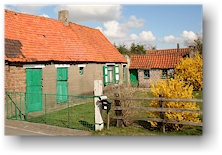 History. History.
The name of the "Damweg" comes from the dike that was
constructed to protect the land from floods. This dike, or
dam, was the extension of the "Branddijk", which was already
mentioned in 1360. The name of another road, the "Groenestraat"
is derived from the "Green Farm", the place where the Klauwaerts
(the Flemish) gathered in 1302 to plan the attack on the
Leliaerts (the French) that occupied the
castle of
Moerkerke.
On the crossroad of the Damweg and
the road to Lapscheure, there used
to be a windmill, called the Hoornmill. It was first used
in 1562 and broken down in 1920. There used to be another,
older mill in the village, name the mill of Houtewerve.
Around 1900, a tramway was
constructed between Bruges
and Aardenburg. This
tram mainly served for the transport of beets and coal.
There used to be a station in the village on the place where now
the church
stands. In 1943, the tram was replaced by a bus.
 At
the end of the Second World War, both parties fiercely battled
in the canal area of the Schipdonk- and Leopoldcanal. German
troops, on this side of the canals, reused the bunkers that were
built here during the First World War and set up heavy artillery
on several farms in the area. Most of these bunkers have been
demolished after the war, but still there are some that remain [see
Hollandline]. In the final weeks of the war, the village
was heavily shelled by allied ground-artillery (operation
Colorado). In 1944, the bridges over the canals were blown
up, so that the hamlet Den Hoorn was cut off from the parish
church in Moerkerke. The villagers
had to go to the school for their prays. At
the end of the Second World War, both parties fiercely battled
in the canal area of the Schipdonk- and Leopoldcanal. German
troops, on this side of the canals, reused the bunkers that were
built here during the First World War and set up heavy artillery
on several farms in the area. Most of these bunkers have been
demolished after the war, but still there are some that remain [see
Hollandline]. In the final weeks of the war, the village
was heavily shelled by allied ground-artillery (operation
Colorado). In 1944, the bridges over the canals were blown
up, so that the hamlet Den Hoorn was cut off from the parish
church in Moerkerke. The villagers
had to go to the school for their prays.
A first emergency church was built
in 1946, it consisted mainly out of material that was left
behind by the German occupator. In 1947, Den Hoorn becomes an
independent parish, with Saint-Rita as patron saint. A second
temperary church was built in 1960. The construction of the
present church commenced in 1975, consecrated by the bishop of
Bruges in 1977. This church was built by voluntary villagers,
under guidance of their priest, Mr. Ackaert. The show-off-piece
of the church is without any doubt the madonna (not the singer!!)
statue, brought from Poland by the priest, Mr. Ackaert.
Nowadays, the church is a well-known pilgrimage place. Each
year, the church wellcomes thousands of pilgrims.
 Den
Hoorn is a peaceful country village, but not so lang ago, some
villagers had a dangerous aditional revenue: smuggling. The
village lies close to the Dutch border, which made it an ideal
base for this clandestine trade. The smuggled goods varied from
butter to living cows. They didn't have a lack of creativity,
the smugglers. Animals were transported in the trunks of cars,
calfs were even dressed up and disguised with a large hat and
put in the front of the car to mislead the border patrols.
This "trade" was certainly nothing for the fearful. The police
was authorized to shoot smugglers if necessary, several were
emprisoned for their actions. This activity reached its peak in
the 50's and 60's of the last century. One of the most
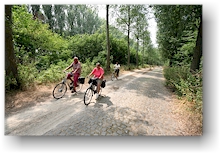
interesting cycling routes of the region is called "de
Smokkelroute" (the smuggling route). Den
Hoorn is a peaceful country village, but not so lang ago, some
villagers had a dangerous aditional revenue: smuggling. The
village lies close to the Dutch border, which made it an ideal
base for this clandestine trade. The smuggled goods varied from
butter to living cows. They didn't have a lack of creativity,
the smugglers. Animals were transported in the trunks of cars,
calfs were even dressed up and disguised with a large hat and
put in the front of the car to mislead the border patrols.
This "trade" was certainly nothing for the fearful. The police
was authorized to shoot smugglers if necessary, several were
emprisoned for their actions. This activity reached its peak in
the 50's and 60's of the last century. One of the most
interesting cycling routes of the region is called "de
Smokkelroute" (the smuggling route).
Agriculture has always been the main
source of revenue here, outside the village center there are
still some old farms. In the village itself you can see some
beautiful typical workers houses. |