
» Aardenburg
» Abbey of Ter Doest
» Adegem
» Bruges
» Castle of Middelburg
» Donk
» Dudzele
» Fort of Bavaria
» Knokke-Heist
» Koolkerke
» Lissewege
» Maldegem
» Male
» Middelburg
» Oedelem
» Sint-Anna-Ter-Muiden
» Sluis
 |
Aardenburg
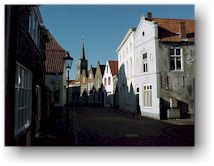 Aardenburg
is one of the oldest towns of Flanders (or should we say the
Netherlands?). Aardenburg is situated in the Netherlands (Zeeuws-Vlaanderen),
just as
Sluis, at merely a few km from the Belgian border. The
first habitation already was here in the Stone Age (around 5500
BC). Remains out of that period, the Roman period and the
Middle Ages can be seen in the town's museum. Aardenburg
is one of the oldest towns of Flanders (or should we say the
Netherlands?). Aardenburg is situated in the Netherlands (Zeeuws-Vlaanderen),
just as
Sluis, at merely a few km from the Belgian border. The
first habitation already was here in the Stone Age (around 5500
BC). Remains out of that period, the Roman period and the
Middle Ages can be seen in the town's museum.
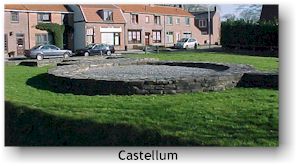 In
the centre, a reconstruction has been made of the foundations of
the Roman castellum that stood here between 170 and 273.
Aardenburg was then called Rodanum Castra, which became
Rodanburg lateron and eventually became Aardenburg. In the year
273, barbarians attack the town and the Romans leave the region.
Only around the 8th century Aardenburg got inhabited again. On
the picture you can clearly see the foundations of the left
tower of the entrygate. For the full reconstruction, we advise
you to go and see with your own eyes. In
the centre, a reconstruction has been made of the foundations of
the Roman castellum that stood here between 170 and 273.
Aardenburg was then called Rodanum Castra, which became
Rodanburg lateron and eventually became Aardenburg. In the year
273, barbarians attack the town and the Romans leave the region.
Only around the 8th century Aardenburg got inhabited again. On
the picture you can clearly see the foundations of the left
tower of the entrygate. For the full reconstruction, we advise
you to go and see with your own eyes.
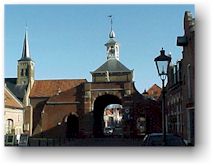 In
1299, the count of Flanders, Guy de Dampierre, ordered to
strenghten the town with walls. Access to the center was
possible via 4 gates. Of these gates, only the Westgate (or
also called Kaaipoort) still stands. This gate stands on where
used to be the quay of the harbour. There no longer is water in
the port, but still its outlines are visible. The Kaaipoort got
his present looks in 1650. The town walls could however not
prevent troops from Ghent from capturing the town in 1383. After
having chased away the Spaniards in 1604, prince Maurits
arranged for the town walls to be strengthened. In
1299, the count of Flanders, Guy de Dampierre, ordered to
strenghten the town with walls. Access to the center was
possible via 4 gates. Of these gates, only the Westgate (or
also called Kaaipoort) still stands. This gate stands on where
used to be the quay of the harbour. There no longer is water in
the port, but still its outlines are visible. The Kaaipoort got
his present looks in 1650. The town walls could however not
prevent troops from Ghent from capturing the town in 1383. After
having chased away the Spaniards in 1604, prince Maurits
arranged for the town walls to be strengthened.
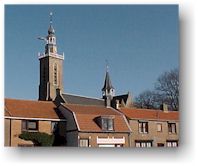 Aardenburg
has two churches: one for the catholics and one for the
protestants. St.-Baafschurch was founded in 959 by monks of the
St.-Baafsabbey of Ghent. The, initially romanesque church, was
rebuilt lateron in gothic style. The upper part of the tower
and the bells date back to the middle of the 17th century. This,
originally catholic, church became protestant in 1578. This one
was however not the largest church in the town, that was the
Mariachurch. This building was torn down in 1625 when a new
defence line was constructed around the town. The present
catholic church was built in the middle of the 19th century. Aardenburg
has two churches: one for the catholics and one for the
protestants. St.-Baafschurch was founded in 959 by monks of the
St.-Baafsabbey of Ghent. The, initially romanesque church, was
rebuilt lateron in gothic style. The upper part of the tower
and the bells date back to the middle of the 17th century. This,
originally catholic, church became protestant in 1578. This one
was however not the largest church in the town, that was the
Mariachurch. This building was torn down in 1625 when a new
defence line was constructed around the town. The present
catholic church was built in the middle of the 19th century.
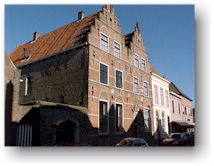 In
the Middle Ages, Aardenburg became a real pilgrimage place after
some miracles took place. Several famous people came here to
worship Maria: king Philips of France, count of Flanders Guy de
Dampierre, duke Philips the Good, kings Edward I, III and IV. In
the Middle Ages, Aardenburg became a real pilgrimage place after
some miracles took place. Several famous people came here to
worship Maria: king Philips of France, count of Flanders Guy de
Dampierre, duke Philips the Good, kings Edward I, III and IV.
Not to be
forgotten: in the port are 4 known "citizens" of Aardenburg: the
water spurting frogs of the frogfountain. This fountain was
placed in 1974 and the frogs represent Aardenburg, Draaibrug,
Sint-Kruis and Eede. In 1830, Aardenburg was temporarily
occupied by the Belgians.
Worth seeing:
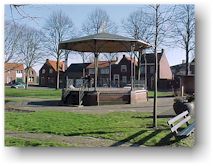
historic center with town hall, market square, kiosk, 2 churches,
Westgate, historic houses, foundations of Roman Castellum,
heritage museum
|











|