|
Vivenkapelle
Pearl of neogothic architecture
 General. General.
The village of Vivenkapelle is a part of the town of
Damme since 1 January 1977, before that
it was a quarter of Sint-Kruis (part of
Bruges). The most
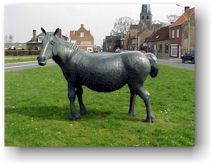
famous inhabitant of Vivenkapelle is without any doubt the
bronze horse of Viven, a masterpiece from the hand of the artist
Jef Claerhout. It was inaugurated in 1977. Worth seeing
in the village are the neogothic complex, the historical farm
"de Vierschare", the protected centre and of course the bronze
horse.
Fixed events.
The old rural feast mid August, village fair in September.
 History. History.
The name Vyve is first recorded
in 1240. In 1350, the lord of Viven was granted permission by
the pope (Clemens VI) to build a chapel. Some 10 years after
that, the village became independent from the magistrates and
the administration of justice of Bruges. In 1355, a "Vierschaere"
or courtroom was mentionned for the first time.
After a pillage by the Geuzen
(protestant religious warriors), the chapel was rebuilt in
1635. In 1797, the chapel was again destroyed, this time by
latitudinarians coming from Bruges. The chapel was then bought
by the family Verhulst in 1827, who rebuilt it and founded 2
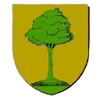
schools on the premises. The depicted weapon in the left
uppercorner for that matter, is the weapon of the family
Verhulst. The present church was consecrated in 1867.
 Vivenkapelle's
neo-gothic complex is (just as the village itself) a protected
monument and consists of a church, a friary, a convent for
sisters and a presbytery. Only 2 of such neo-gothic complexes
exist in Belgium (click
here for more details). Besides this, a few very beatiful
old farms ornament the village. In the direction of
Moerkerke, at a few 100 meters from
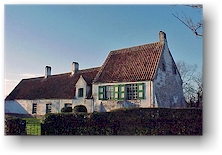
the church, still lies the (partially surrounded by a ditch)
house of the family Verhulst. In front of it stands the small
chapel of St.-Joseph from 1870. Vivenkapelle's
neo-gothic complex is (just as the village itself) a protected
monument and consists of a church, a friary, a convent for
sisters and a presbytery. Only 2 of such neo-gothic complexes
exist in Belgium (click
here for more details). Besides this, a few very beatiful
old farms ornament the village. In the direction of
Moerkerke, at a few 100 meters from
the church, still lies the (partially surrounded by a ditch)
house of the family Verhulst. In front of it stands the small
chapel of St.-Joseph from 1870. |