|
Moerkerke
Church and castle in the wetlands
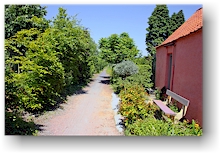 General. General.
With a little over two thousand inhabitants, Moerkerke is the
largest but one village in Damme. Around the centre of the
village, there is a lot of green. Alongside the
Leopoldcanal and the
Schipdonkcanal, you can
make very nice hikes and bicyclerides. Or you can just
enjoy the extensive polders around Moerkerke with their old
farms and numerous little chapels.
Fixed events.
Castle feasts on the last Sunday of August, village fair
during the second weekend of October.
Name.
The name "Moerkerke" comes from "chuch in a morass". The
morass refers to the wet coastal area of the 12th century.
History.
Our first records go back to 1110. As explained above, the name
"Moerkerke" means church in a marsh, but in the beginning there
was no church in the village, but a chapel. This chapel fell,
as did so many other ones in the region, under the authority of
the church
of Oostkerke. Moerkerke probably became a indendent parish
after the construction in the 12th century of a seadike between
Damme and
Den
Hoorn
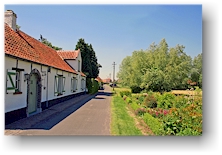 The
present church was consecrated in 1870 and its patron saint is
Saint-Dionysius. About the churches that stood here before,
little is known. In the beginning of the 15th century, repairs
were carried out. In 1547, the tower collapsed and was rebuilt
2 years later. In 1600, the church was destroyed. The
reconstruction was completed in 1654. Eventually, the church
was replaced by the present one. At the end of the Second World
War (September 12th 1944 to be precise), the tower was shot down
by 9 German grenades, fired from artillery placed on the other
side of the canals (see
battle for "het Molentje"). After the war, the tower was
rebuilt (busy people...) and is about 7 meters lower and a bit
different in shape than the previous tower The
present church was consecrated in 1870 and its patron saint is
Saint-Dionysius. About the churches that stood here before,
little is known. In the beginning of the 15th century, repairs
were carried out. In 1547, the tower collapsed and was rebuilt
2 years later. In 1600, the church was destroyed. The
reconstruction was completed in 1654. Eventually, the church
was replaced by the present one. At the end of the Second World
War (September 12th 1944 to be precise), the tower was shot down
by 9 German grenades, fired from artillery placed on the other
side of the canals (see
battle for "het Molentje"). After the war, the tower was
rebuilt (busy people...) and is about 7 meters lower and a bit
different in shape than the previous tower
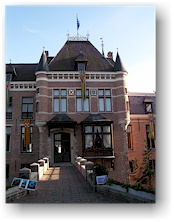 Through
marriage, the manor Moerkercke passed from the family "van
Moerkerke" on to the family "van Praet". The reputation of the
stronghold is closely related to the name "van Praet", an old
noble family (see also
Oedelem). The
castle is without any doubt, the pride of the village. It
has luckily been tastefully restored after years of decay. The
halls of the castle now serve as ball-rooms and reception rooms
for festivities. Who doesn't dream of a noble marriage in a
medieval chateau? Through
marriage, the manor Moerkercke passed from the family "van
Moerkerke" on to the family "van Praet". The reputation of the
stronghold is closely related to the name "van Praet", an old
noble family (see also
Oedelem). The
castle is without any doubt, the pride of the village. It
has luckily been tastefully restored after years of decay. The
halls of the castle now serve as ball-rooms and reception rooms
for festivities. Who doesn't dream of a noble marriage in a
medieval chateau?
The castle of Moerkerke is not
the only one on the territory of the village. Not far from the
road to Vivenkapelle, there's the
castle of
Altena. It stands in fact closer to the church of
Vivenkapelle than the church of Moerkerke, but it still is on
Moerkerke's territory.
In the midst of the fields
between Moerkerke and Sijsele there
used to be the convent of Sarepta. In 1468, the sisters of St.-Elisabeth
settled down here. Already a good century later, the sisters
had to abandon their convent because of the threat of the Geuzen
(protestant religious fighters). In 1586, the structures were
burnt to the ground by the Geuzen. The stones of the old church
of Sarepta were used in 1923 to erect the chapel of Sarepta.
This chapel was bought and cleaned up a few years ago by the
local heritage circle (Heemkundige Kring Zwin Rechteroever).
 Out
of the 7 mills there used to be in the village, not even one
still remains. The quarter "het Molentje" thanks its name to a
mill that used to be there untill 1922. It was a wooden
standardmill which was used during more than 150 years by the
same family. "De molen van Schuts" (named by the villagers that
way, after the name of the last millner) initially was a wooden
mill too, but was rebuilt in in stone 1858. This mill was shot
on fire by Canadian tanks on 12 September 1944, because they
thought it was used by the Germans as a look-out post. The
stone walls remained until 1957; then the ruins of the mill were
pulled down. Out
of the 7 mills there used to be in the village, not even one
still remains. The quarter "het Molentje" thanks its name to a
mill that used to be there untill 1922. It was a wooden
standardmill which was used during more than 150 years by the
same family. "De molen van Schuts" (named by the villagers that
way, after the name of the last millner) initially was a wooden
mill too, but was rebuilt in in stone 1858. This mill was shot
on fire by Canadian tanks on 12 September 1944, because they
thought it was used by the Germans as a look-out post. The
stone walls remained until 1957; then the ruins of the mill were
pulled down.
The most notorious page in the
history book of Moerkerke is not such pleasnant one. In 1944, a
fierce battle took place around the quarter "het Molentje",
known as the battle for "het Molentje". |