» Herringmarket » Bruges Gate » Farm Saint Christopher » Farm the "Stamper" » Slekkeput » House Saint John » Damme town hall » Slekkeput » Saint-John's hospital » Medieval waterwell » Lock of the Lieve » Waterpumps » Statue J.Van Maerlant » Casemates » Damme town walls » Schellemill » NR Damme town walls » Damse Vaart » Bat reserve » Leopoldcanal » Schipdonkcanal » Damme book village » Museum St-John's hospital » Museum town hall » Museum Schellemill  » Hoeke church » Lapscheure church » Vivenkapelle church » Saint-Dyonisiuschurch » Saint-Quintenschurch » Saint-Martinschurch » Saint-Ritachurch » Ruins old church Lapscheure |
Our Ladies church of Damme
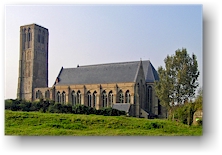
The tower of the church of Damme reigns over the polderlandscape. The church is one of the most known monuments of the medieval town; this is largely due to her flat tower. Churches with flat towers are unique and can practically exclusively be seen in the polders. Also the churches of Lissewege, Oostkerke and St.-Anna Ter Muyden have such a flat tower. Shortly after Damme was founded, there already was a temporary chapel, which depended on the church of Oostkerke, which is older than Damme. In 1225, the construction of the present church commenced (and then the tower did have pointed little cornertowers!). The town was prosperous, grew very fast and soon the church was too small. In 1340, she was then enlarged. In 1578, Geuzen (protestant religious warriors) plundered the church, after which she was restored between 1621 and 1626. However, prosperity didn't last. Depopulation made the church now too big and the invoice for the maintenance too high. In 1704, the first talks commence regarding the pulling down of a part of the church. Eventually in 1725, the High Council of Mechlin gives her permission for the demolition. The part between the tower and what is now the church, was pulled down; only the round arches had to remain to support the tower. Also the decayed pointy tower was removed. The recuperated materials were then sold.
|
          
|
 Location: Kerkstraat, 8340 Damme [gps]
 The
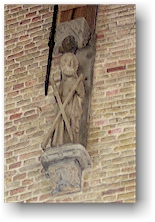
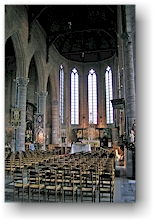
interior is worth a detour and contains a treasure of rare
pieces. The big pride of the church are without any doubt the
13th century (!) wooden statues of the apostles. It may be
considered as a miracle that they survived the religious
troubles of the 16th century. In the middle of the cross altar
stands that cross of miracles; according to the legend, this
cross was fished up out of the sea by fishermen, who then
brought it to the church. This cross is carried in the annual
Procession of the Holy Blood in Bruges. Further there are
fragments of 14th century wall-paintings , a baroque
confessional (17th century, coming from the St.-Donaascathedral
of Bruges which was torn down by the French in 1801), the chapel
of the Holy Sacrament (1485), the altar of Saint-Anna (16th
century) and other altars and much much more. No better way
then to go and discover it for yourselves. For the amateurs:
there are also still a number of very old tombstones (who looks,
finds...) in the church. The oldest tomb from Damme (1294) was
kept in the Bijlokemuseum in Ghent. But, appearantly it
dissapeared from there without any trace... Would the one who
has the tombstone now, please return it? We won't be mad. For
a detailled description of all the beautiful artefacts and
relics in and outside, you'd best appeal to an experienced
The
interior is worth a detour and contains a treasure of rare
pieces. The big pride of the church are without any doubt the
13th century (!) wooden statues of the apostles. It may be
considered as a miracle that they survived the religious
troubles of the 16th century. In the middle of the cross altar
stands that cross of miracles; according to the legend, this
cross was fished up out of the sea by fishermen, who then
brought it to the church. This cross is carried in the annual
Procession of the Holy Blood in Bruges. Further there are
fragments of 14th century wall-paintings , a baroque
confessional (17th century, coming from the St.-Donaascathedral
of Bruges which was torn down by the French in 1801), the chapel
of the Holy Sacrament (1485), the altar of Saint-Anna (16th
century) and other altars and much much more. No better way
then to go and discover it for yourselves. For the amateurs:
there are also still a number of very old tombstones (who looks,
finds...) in the church. The oldest tomb from Damme (1294) was
kept in the Bijlokemuseum in Ghent. But, appearantly it
dissapeared from there without any trace... Would the one who
has the tombstone now, please return it? We won't be mad. For
a detailled description of all the beautiful artefacts and
relics in and outside, you'd best appeal to an experienced
 Church
and tower are a protected monument and are open to the public.
Only the church is accessible to wheelchair users. The one who
likes a firm climb, definitely has to visit the tower. From the
top, you have a splendid view on the town, the defence walls,
and the wide landscape around.
Church
and tower are a protected monument and are open to the public.
Only the church is accessible to wheelchair users. The one who
likes a firm climb, definitely has to visit the tower. From the
top, you have a splendid view on the town, the defence walls,
and the wide landscape around.