» Bruges Gate » Farm "De Stamper" » Farm Saint-Christopher » House "De Grote Sterre" » House Saint-John » Casemates » Medieval waterwell » Our Ladies Church » Lock of the "Lieve" » Schellemill » Town Hall » Town walls » Saint-John's Hospital » "Slekkeput" » Waterpumps  » Reserve "The town walls" » Canal "Damse Vaart" » Bat reserve  » Canal "Damse Vaart" » Leopoldcanal » Schipdonkcanal  » Book village » Museum St.-John's Hospital » Museum Town Hall » Museum Schellemill » Museum C. Delporte » Museum Uilenspiegel  » Herring Market » Statue J. Van Maerlant
|
Damme
Fixed events.
Name.
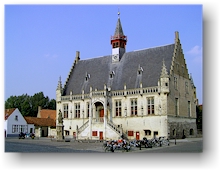
In order to stimulate trade, in 1180, count Philips from Alsace gave Damme townprivileges and exemption of tollrights. Seaships could sail as far as Damme, where their goods were then overloaded onto smaller boats. Via a canal, these boats could reach Bruges. During the first century of it's existence, Damme lived to see it's greatest flourishing; the oldest monuments in the town center still date back to that age. Next to the transfer of goods, Damme also had the staplerights on wine and herring (see Herringmarket/Haringmarkt). The town flourished and grew fast and soon the construction of the church (Our Ladies church) commenced. Soon hereafter the Halls and the Saint-John's hospital were built. In that age, a lot of other (already dissapeared buildings) were constructed like: a begijnhof, a guesthouse and several chapels. The, also dissapeared, St.-Catherinschurch dates back to that time; this building stood just outside the present town walls. There was also a court of justice, which proves the importance of the town. Damme was one of the largest harbours of it's age. When the French king Phillips August captured the town in 1213, his entire fleet (1700 vessels!) fitted into the harbour
Untill that time, Damme was an open town without walls and defence gates. This changed when in 1297, the French king Phillips captured the town. Damme was quite rapidly recaptured by the Flemish. As a result, the first defence structures were constructed. At the end of the 14th, begin 15th century a second wall was built around the town In the course of time however, the access to the harbour silted up and the largest ships could no longer reach Damme directly. At the beginning of the 14th century, the main trade shifted to other harbours, located closer to the sea. Especially Lamminsvliet (later on called Sluis), benefited from this. Damme slowly lost it's importance as international tradecenter, but the town was far from dead: it got a new role in history as a military fortress In 1568, the 80-year war between Spain and the Northern Netherlands started. When, in 1604, Sluis and Aardenburg were conquered by prince Maurits, Damme found itself in the fronline of the war. Between 1615 and 1620, the Spaniards built new defencewalls in the shape of a 7-star. These walls are still pretty well preserved and are being restored. Damme was important because of it's position on the canals, close to Sluis and ideal to defend Bruges. The mouth of the "Lieve" (canal Ghent-Damme) was redirected inside the walls and entered the town via a covered watergate. That gate was later on used as a weapon storage ("casemate") and still exists. Because of the construction of the new walls, several buildings had to be pulled down (such as the old gates). The town, or better: the fortress, could only be accessed via 2 new gates. A military governor ruled the town and it would remain a military stronghold untill 1760
During the Spanish Successionwar (1703-1713) the fortifications were again strengthened. Despite all these efforts, the town was captured in 1706 by troops of the duke of Marlborough. Some 80 years later, the fortifications were publically sold on the command of emperor Joseph II.
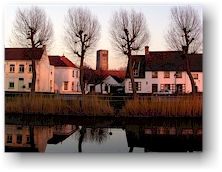
Damme had decayed to not much more than a small agricultural village. Upcoming tourism however in the 20th century, put the town back on the map. The cultural heritage is the living witness of the rich past Damme has. This small town now is cosy place where it is pleasant to stay. |
          
|

 General.
 History.
 In
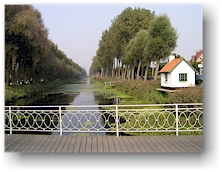
1262, a canal (called the "
In
1262, a canal (called the "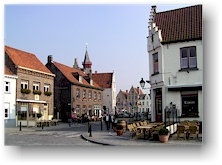 In
1810, Napoleon tried to link Bruges with the Schelde via a new
canal. This plan was never entirely completed and at present
day, the canal goes no further than
In
1810, Napoleon tried to link Bruges with the Schelde via a new
canal. This plan was never entirely completed and at present
day, the canal goes no further than